- 111/401 Shipra Path, Mansarovar, Jaipur – 302020
- 8.30 AM – 5.00 PM
- Email: kidzee4509@kidzee.com
- Phone: 76655 88038

Almost every parent hits the same wall when they start looking at preschools. One school talks about Playgroup and Nursery, the next one lists Junior KG and Senior KG, a third throws in Pre-KG and Prep. It sounds like an alphabet puzzle, and it is easy to feel lost before you have even visited a single classroom.
The good news is that the system underneath is simpler than the names suggest. This guide explains the real difference between Playgroup, Nursery, LKG and UKG: the age for each stage, what children actually do at that level, the correct order, and how to work out which stage your child should start with. By the end you will be able to read any preschool’s admission form without second guessing yourself.
Preschool in India runs in four steps before formal school begins:
Playgroup, then Nursery, then LKG, then UKG, and after that the child enters Class 1.
Each step is decided by the child’s developmental readiness, not by strict academics. A younger child needs comfort and play. An older one is ready for a little more structure. The stages simply follow that curve, adding a bit more routine and learning at each level.
Before the ages, clear up the names, because this is where most of the confusion comes from. Different schools use different words for the exact same stage.
So if one preschool offers Playgroup, Nursery, Junior KG and Senior KG, and another offers Playgroup, Nursery, LKG and UKG, they are offering the same four stages. Junior KG is LKG. Senior KG is UKG. Once you know that, half the confusion disappears.
Here is the age band most Indian preschools follow. Treat these as the common convention rather than a fixed law, because the exact cut-off shifts a little from school to school and state to state.
| Stage | Also called | Typical age | Main focus | Balance of play and structure |
|---|---|---|---|---|
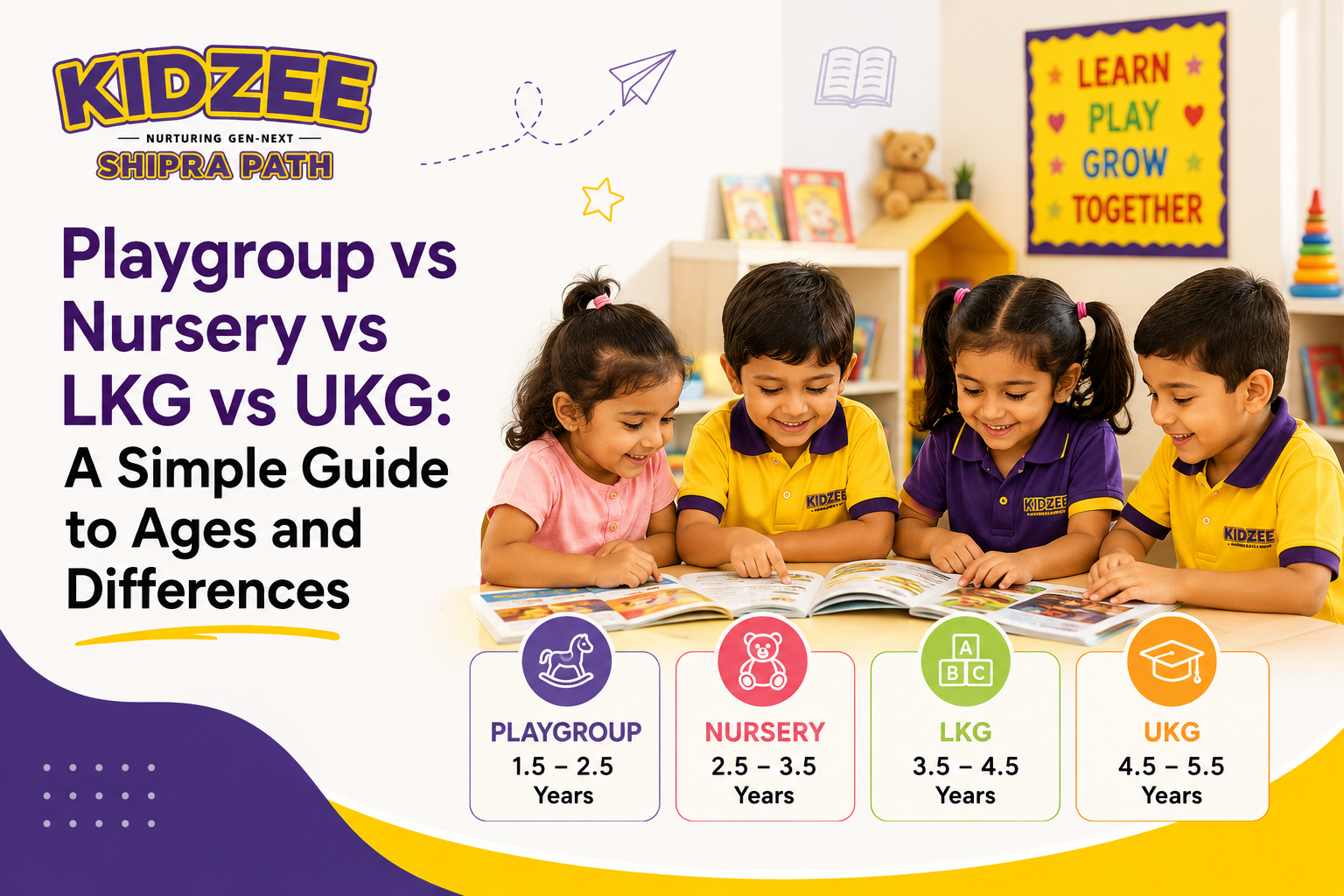
| Playgroup | Play Group, Pre-Nursery | 1.5 to 2.5 years | Settling in, free play, social basics | Almost entirely play |
| Nursery | Pre-KG, Prep | 2.5 to 3.5 years | Routines, language, colours and shapes | Mostly play with light structure |
| LKG | Junior KG, Jr KG | 3.5 to 4.5 years | Pre-reading, pre-writing, early numbers | Roughly 60 play, 40 guided |
| UKG | Senior KG, Sr KG | 4.5 to 5.5 years | Reading, writing and number readiness | Roughly half play, half structured |
The single most useful thing to remember is that each stage adds a little more learning while keeping play at the centre. Nobody should be pushing a two year old through worksheets, and no five year old should be sitting silent at a desk all day.
Playgroup is usually a child’s first experience of the world outside home, so the whole point of it is comfort, not academics. A good playgroup helps a child do three things: separate from a parent without lasting distress, get used to being around other children, and start exploring through their senses.
The day is built around free play, songs, simple crafts, water and sand, blocks, and lots of movement. Teachers work quietly on basics like sharing, waiting, and using a few words to ask for things. There is no reading, no writing, and no pressure. If you visit a playgroup and see toddlers filling notebooks, that is a warning sign, not a selling point. At this age the child’s job is to feel safe and curious.
By Nursery, most children have settled into being away from home, so the class can add a gentle layer of routine. The focus moves to language and early concepts, still delivered through play.
Children learn to follow a daily rhythm: arrival, circle time, activity, snack, and outdoor play. They pick up colours, shapes, and everyday vocabulary, listen to stories, and start to hold a crayon with some control. Fine motor work like stringing beads and stacking builds the hand strength they will later need for writing. Nursery is also where many children make their first real friendships. It should still be roughly nine parts play to one part structure.
LKG, or Lower Kindergarten (the same class many schools call Junior KG), is where the first real shift toward learning happens. Children are more settled and more curious, so the teacher can introduce pre-reading and pre-writing without turning the class into a drill.
At this stage children begin recognising letters and numbers, tracing patterns that prepare the hand for writing, hearing the sounds that letters make, and following slightly longer activities. The important word is begin. There is a wide range of what is normal here. One four year old may already read a few simple words while another is just learning to recognise letters, and both are completely fine. The job of LKG is to build confidence and curiosity, not to produce tiny scholars.
UKG, or Upper Kindergarten (also called Senior KG), is the bridge between play based early years and the more formal world of Class 1. By now most children have the attention span and the social skills to handle more structure.
Children in UKG typically read simple words and short sentences, write letters and numbers, attempt basic addition and subtraction, build general awareness, and practise independence like packing their own bag and following a multi step instruction. Play is still there, but desk based activities increase, and this is where the idea of school readiness becomes real. A strong UKG year makes the jump to Class 1 feel natural rather than sudden.
If you have seen nursery listed as 2.5 to 3.5 years on one website and 3 to 4 years on another, you are not imagining it. Three things cause this.
First, the cut-off date. Most schools require a child to reach the minimum age for a class by a fixed date, commonly the 31st of March, though some use the 30th of June. A child born in April and a child born in February can end up in different classes even at the same age in months.
Second, state and school policy. India does not run one single standard for pre-primary, so each school sets its bands within broad norms.
Third, the shift under NEP 2020. The National Education Policy places these years inside the Foundational Stage, which covers ages three to eight and includes three years of preschool before Grades 1 and 2. It also moved the common Class 1 entry age toward six years, which nudges the whole preschool ladder along with it. The practical takeaway is simple: always confirm the exact cut-off date with the specific school before you assume which class your child qualifies for.
Yes, and many children do. It is common for a child to enter formal school for the first time directly at Nursery, or even at LKG, without having done Playgroup. If there is no earlier registered school, most schools waive the Transfer Certificate too.
But there is a trade-off worth being honest about. A child who has never been in a group setting and joins straight into LKG has to manage two big things at once: separating from home and coping with more structure. Some children handle it smoothly. Others need extra weeks to settle and may find the pace harder than classmates who did the earlier stages. If your child is shy or has had little time around other children, an earlier, gentler entry usually pays off.
Work with two things together: age and readiness.
Start with age as of the school’s cut-off date, which gives you the stage your child is eligible for. Then look at readiness. Can your child manage a few hours away from you without lasting distress? Can they communicate a basic need, follow a simple instruction, and sit for a short activity? For the older stages, toilet training also matters. If the age points to LKG but your child has never been in a group and struggles to separate, it is often kinder to begin a step lower and let them build confidence rather than force the pace.
If you are comparing preschools around Mansarovar and Shipra Path, you will see both naming styles on the boards, so remember the map: Junior KG is LKG, and Senior KG is UKG. At Kidzee Shipra Path, for example, the four stages run as Play Group, Nursery, Junior KG and Senior KG, covering roughly 1.5 to 5.5 years. Since Jaipur schools set their own cut-off within state norms, confirm the date with each centre before you finalise the class, especially if your child’s birthday falls close to the boundary.
LKG stands for Lower Kindergarten and UKG stands for Upper Kindergarten. Many schools call the same classes Junior KG and Senior KG.
Nursery comes first. The order is Playgroup, then Nursery, then LKG, then UKG, and after that Class 1.
No. Nursery is mostly play and focuses on routines, language and social skills for children around 2.5 to 3.5 years. LKG comes after it and introduces early reading, writing and numbers for children around 3.5 to 4.5 years.
Commonly around 3.5 to 4.5 years, but the deciding factor is the child’s age as of the school’s cut-off date. Confirm that date with the school.
It is not compulsory. Many children start at Nursery or later. That said, Playgroup makes the first separation from home easier, which helps children who are shy or have had little group time.
Yes. Many children enter formal school for the first time at LKG, and the Transfer Certificate is usually waived if there was no earlier registered school. Just be ready for a slightly longer settling in period.
Playgroup, Nursery, LKG and UKG are not four separate worlds. They are four gentle steps along the same path, each adding a little more learning while keeping play at the centre. Once you see the order and remember that Junior KG means LKG and Senior KG means UKG, choosing the right stage becomes a matter of your child’s age and readiness rather than guesswork.
If you would like help placing your child in the right stage, you are welcome to visit Kidzee Shipra Path (My Little Steps) in Mansarovar. We run all four stages from Play Group to Senior KG and can talk you through the right fit for your child’s age and comfort. To book a visit, call 76655 88038 or come by 111/401 Shipra Path, Mansarovar, Jaipur.
Get all the latest information, support and guidance about the cost of living with kindergarten.
Start Registration